Nuclear energy and the industrial decarbonization imperative
Every credible net-zero pathway agrees on one thing: electricity must decarbonize.
Wind, solar, and storage dominate the public conversation around the energy transition. They attract the majority of political attention, investment flows, and infrastructure planning.
They are necessary. They are not sufficient. Because electricity is only part of the challenge.
Heat, the energy used to forge steel, fire cement kilns, refine chemicals, and process industrial feedstocks, accounts for nearly half of global final energy consumption, according to the International Energy Agency. In industry specifically, heat remains the dominant energy input, and the vast majority of it is still generated by burning fossil fuels directly.
This is one of the most structurally difficult problems in the energy transition. And it is one that nuclear may be uniquely positioned to help solve.
Industrial decarbonization has a heat problem
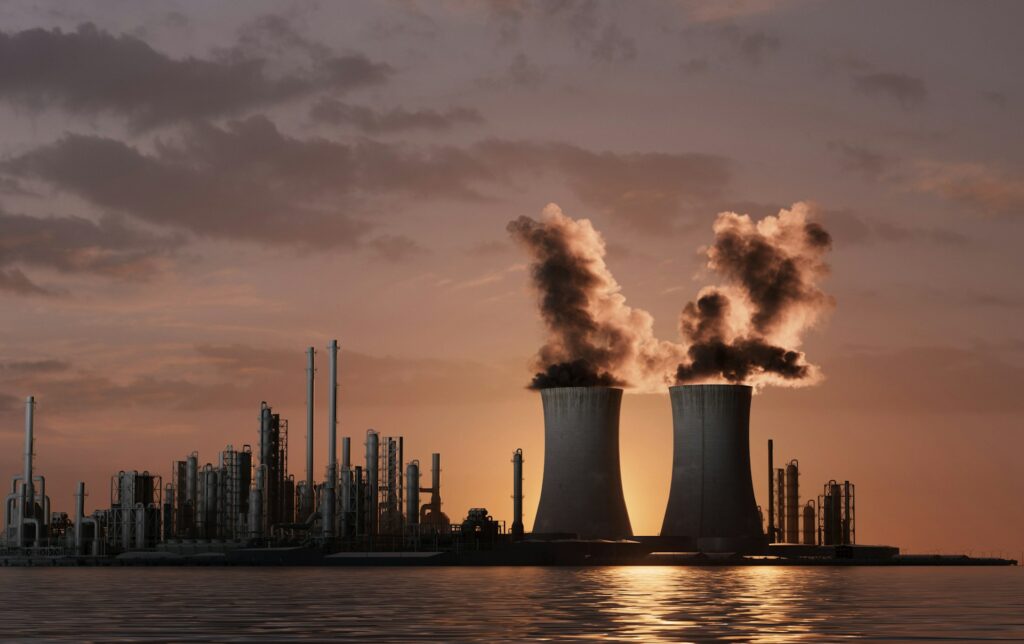
Industry remains the largest source of direct carbon emissions globally, accounting for approximately 37% of total CO₂ emissions when direct combustion and indirect electricity-related emissions are combined.
Within that total, a small number of sectors drive a disproportionate share of the challenge.
Steel production alone contributes roughly 7% of global CO₂ emissions, with blast furnace processes requiring temperatures above 1,000°C. Cement production typically requires kiln temperatures of 1,400–1,500°C and generates unavoidable process emissions from limestone calcination. Chemical manufacturing spans a wide range of heat-intensive applications, many of which require continuous, high-temperature energy across highly integrated process chains.
These are not peripheral sectors. They are foundational to the global economy — and among the hardest to decarbonize.
Why existing pathways leave a gap
Most industrial decarbonization strategies currently rely on three pathways: electrification, hydrogen, and carbon capture.
Each has a role to play. None fully solve the heat challenge on their own.
Direct electrification is effective for lower-temperature industrial applications and will remain an important part of the transition. But for many continuous, high-temperature processes, scaling electric heat economically remains challenging.
Green hydrogen holds significant long-term promise, particularly in steelmaking and chemicals. Yet cost, infrastructure requirements, electrolyser deployment, and renewable power availability continue to constrain large-scale deployment. For many industrial operators, hydrogen remains a medium- to long-term pathway rather than an immediate solution.
Carbon capture can reduce emissions from existing fossil-fired processes, but it does not eliminate dependence on combustible fuels. It reduces the carbon intensity of the system without fundamentally changing its underlying energy architecture.
The result is a persistent gap in the industrial decarbonization toolkit:
a shortage of scalable, clean, continuous high-temperature heat solutions.
Why nuclear deserves greater attention
Nuclear reactors produce heat first and electricity second. That matters.
Conventional light water reactors already generate steam at approximately 300°C, suitable for district heating and a range of lower-temperature industrial applications. But the more significant strategic opportunity lies in advanced reactor technologies designed specifically for higher-temperature output.
High-Temperature Gas-cooled Reactors and Very High Temperature Reactors are designed to deliver outlet temperatures in the 700–950°C range, making them relevant for a far broader range of industrial applications. At the upper end of that spectrum, they also enable more efficient hydrogen production pathways than conventional electrolysis.
This is not theoretical physics but an engineering and deployment challenge.
Nuclear process heat has already been demonstrated across multiple non-electric applications, and high-temperature industrial integration is increasingly moving from conceptual design toward commercial demonstration.
The market is beginning to move
Momentum is building.
China’s HTR-PM at Shidaowan became the world’s first commercial high-temperature gas-cooled reactor in 2023, establishing a critical proof point for advanced nuclear heat technologies. In the United States, the Department of Energy’s Industrial Decarbonization Roadmap identifies advanced nuclear as a strategic option for industrial heat supply, while national laboratories continue developing integration models for nuclear-industrial thermal systems.
At the same time, several advanced reactor developers such as Jimmy are explicitly designing their commercial offerings around industrial heat applications rather than grid-only electricity supply.
The emerging model is clear:
co-located nuclear and industrial assets, linked through long-term thermal offtake arrangements.
For industrial operators, this creates the possibility of securing stable, low-carbon heat directly at source while reducing exposure to grid congestion, transmission losses, and power market volatility.
Why this matters strategically
For many industrial operators, energy is not just an emissions issue. It is a competitiveness issue.
Steel, cement, and chemicals are globally traded commodities produced in margin-sensitive environments. Energy price volatility directly impacts operating margins and long-term investment decisions.
The European energy crisis of 2022–2023 exposed the vulnerability of industrial sectors reliant on gas-fired heat. Meanwhile, mechanisms such as the EU’s Carbon Border Adjustment Mechanism are turning carbon intensity into an increasingly explicit financial variable for exporters into European markets.
In this context, decarbonized industrial heat is no longer simply an ESG consideration.
It is becoming a strategic determinant of industrial competitiveness.
Nuclear process heat offers a pathway to address that challenge structurally: delivering continuous, carbon-free thermal energy with long-term pricing stability and limited fuel cost exposure.
The window for strategic positioning is open now
High-temperature nuclear heat is not yet available at broad commercial scale.
But industrial decarbonization decisions are not made on deployment timelines alone. They are shaped by long asset cycles, infrastructure planning horizons, and regulatory lead times.
Industrial assets commissioned today may operate for 30 to 50 years. Energy infrastructure decisions made in this decade will shape competitiveness and emissions trajectories well beyond 2050.
The companies that begin assessing nuclear heat pathways now, evaluating site compatibility, technology readiness, regulatory implications, and commercial structures, will be better positioned when deployment reaches maturity.
Those that wait for the technology to become fully commoditized may find that the strategic window has already narrowed.
A strategic reframing
The industrial heat challenge remains one of the least discussed, and most consequential, bottlenecks in the energy transition.
Nuclear may not be the answer for every industrial application.
But for many hard-to-abate sectors, it is one of the few scalable pathways to address the problem at its source.
The question is no longer whether industrial heat must decarbonize.
It is which technologies, and which operators, will move early enough to shape that transition rather than react to it.
Related posts

The signal behind India’s uranium diplomacy